Stage One: The Initial Discovery
It starts with a sound. Not a dramatic, movie-explosion kind of sound that would force you to pull over immediately. No, this is much more insidious. It's a subtle click-click-whirr that happens only when you're turning left at speeds between 15 and 23 mph on Tuesdays.
Your first reaction is perfectly reasonable: "Huh, that's weird." You turn down the radio for exactly three seconds to listen more carefully, then immediately turn it back up because ignorance is bliss and Spotify has bills to pay.
This is the moment of truth. This is where responsible adults would schedule a diagnostic appointment or at least make a mental note to mention it to someone who knows about cars. But you? You're about to embark on a masterclass in automotive denial that would make ostriches jealous.
The Google Trap: When Knowledge Becomes Dangerous
Against your better judgment, you decide to do a quick Google search. Just to satisfy your curiosity, you tell yourself. Definitely not because you're worried or anything.
"Car making clicking noise when turning left."
The first result mentions something about CV joints, which sounds expensive. The second result talks about wheel bearings, which also sounds expensive. The third result is from a forum where someone with the username "CarGuru47" suggests it could be anything from a loose bolt to complete transmission failure.
You close the laptop immediately. This was a mistake. You were happier thirty seconds ago when you knew nothing about CV joints. What even is a CV joint? It sounds made up. It sounds like something mechanics invented to pay for their kids' college tuition.
The Expert Consultation: Asking Your Friend Who "Knows Cars"
Desperate for reassurance, you text your friend Mike, who once changed his own oil and therefore qualifies as your personal automotive consultant.
"Hey, my car is making a clicking noise when I turn left. Should I be worried?"
Mike, bless his heart, responds with the confidence of someone who has watched exactly two YouTube videos about car maintenance: "Oh yeah, that's probably just the thing connecting to the other thing. Nothing serious. My cousin's car did that for like two years."
This is exactly what you wanted to hear. Mike's cousin's anecdotal evidence is now the foundation of your entire automotive philosophy. If it worked for Mike's cousin – who you've never met and whose mechanical expertise is completely unknown – then it'll work for you too.
The Volume Solution: Engineering at Its Finest
Armed with Mike's expert opinion and your own desire to avoid spending money, you implement the most sophisticated car repair technique known to modern civilization: turning up the radio.
It's brilliant, really. If you can't hear the problem, does the problem really exist? This is basically Schrödinger's car repair. The clicking noise exists in a quantum state of both happening and not happening, depending on whether or not you're actively listening to it.
You upgrade your Spotify subscription to premium just to ensure you have uninterrupted, problem-masking audio. This is a small price to pay for peace of mind, and definitely much cheaper than whatever a mechanic would charge to fix a "CV joint," which you're still convinced is probably just a fancy name for "that round thing that spins."
The Escalation: When One Noise Becomes a Symphony
But cars, much like small children and houseplants, don't respond well to being ignored. The clicking noise decides it's lonely and invites some friends to the party. Now there's a subtle grinding sound that happens when you brake, and occasionally a squeak that you're pretty sure is just the weather.
You handle this development with the same masterful denial that got you this far. The grinding is obviously just the brake pads doing their job – they're supposed to make contact, right? That's literally how brakes work. And the squeaking? That's definitely just moisture. Or maybe your car is trying to communicate with nearby birds. Either way, it's not a problem.
The Mechanic Consultation: A Study in Interpretive Dance
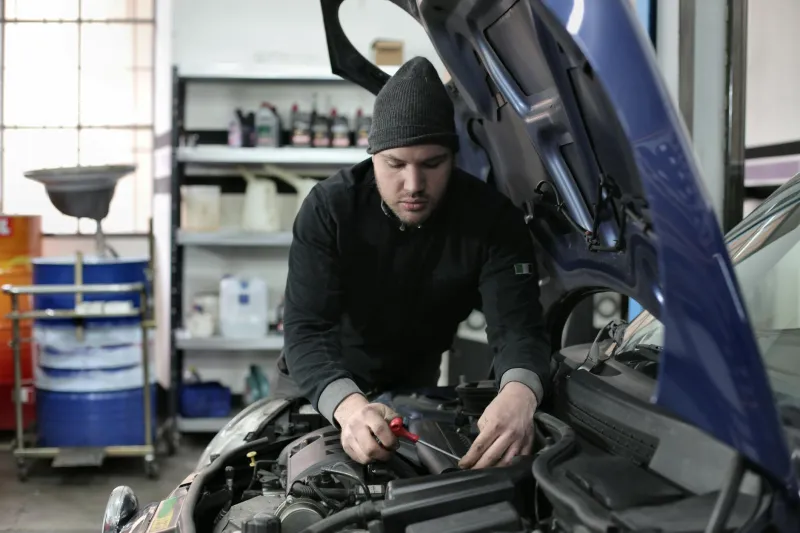
Finally, after months of successful problem avoidance, something happens that forces you to visit an actual mechanic. Maybe it's an oil change, or maybe the check engine light has joined the cacophony of issues you're ignoring. Either way, you find yourself in the uncomfortable position of having to describe your car's symptoms to a professional.
"So, it's making this noise," you begin, then proceed to perform what can only be described as automotive interpretive dance. You make clicking sounds with your tongue while gesturing vaguely at the front of your car. You demonstrate the grinding noise by rubbing your palms together, and you recreate the squeak by making a sound that's somewhere between a mouse and a rusty hinge.
The mechanic watches this performance with the patience of someone who has seen this exact dance approximately 10,000 times. They nod seriously, as if your mouth-sounds are providing valuable diagnostic information.
The Moment of Truth: When Reality Comes Knocking
"Well," says the mechanic, "let me take a look."
This is the moment you've been dreading. This is when your carefully constructed house of automotive denial comes crashing down. The mechanic is going to tell you that your CV joint (which you've now accepted is a real thing) needs to be replaced, and it's going to cost more than your monthly rent.
But here's the plot twist: sometimes – just sometimes – your denial was actually justified. Sometimes the mechanic comes back and says, "You know what? It's just a loose bolt. Twenty-dollar fix."
And in that moment, you feel vindicated. You were right to ignore the problem! You were right to trust Mike's cousin's automotive wisdom! You are basically a car whisperer, capable of diagnosing problems through sheer intuition and willful ignorance.
The Dangerous Precedent: When Success Breeds Confidence
This single victory – this one time when ignoring a car problem actually worked out – becomes the foundation for years of future automotive denial. Every new noise, every strange vibration, every mysterious dashboard light gets the same treatment: strategic ignorance combined with volume adjustment.
You become a connoisseur of car problems, able to distinguish between "definitely nothing" and "probably nothing" and "almost certainly nothing but I should maybe mention it to Mike." You develop a sophisticated rating system based on how loud the noise is, how often it happens, and how much it would cost to fix if it were actually a problem.
The Philosophy: Embracing the Zen of Automotive Uncertainty
Eventually, you reach a kind of enlightenment about car ownership. You realize that cars, like life itself, are inherently mysterious. They make noises for reasons that mortal humans cannot comprehend. They vibrate according to cosmic forces beyond our understanding. They exist in a state of constant near-breakdown that somehow never quite tips over into actual breakdown.
And really, isn't that beautiful? Isn't there something poetic about driving around in a machine that defies your expectations every single day? Your car has been "about to break down" for three years now, and yet it continues to get you from point A to point B with nothing more than the occasional interpretive sound effect.
Maybe the real automotive expertise was the problems we ignored along the way. Maybe the true measure of a car owner isn't how well they maintain their vehicle, but how creatively they can rationalize avoiding maintenance while still getting where they need to go.
Or maybe you should probably just take it to a mechanic. But where's the adventure in that?