The Crime Scene Investigation That Begins the Moment You Smell Something Weird in Your Car
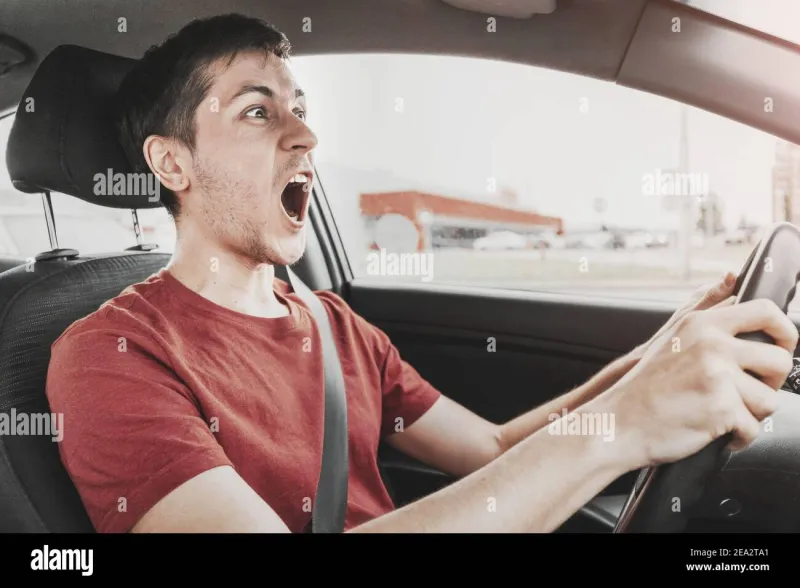
Photo: person looking confused and disgusted inside car holding nose, via c8.alamy.com
It starts subtly. A hint. A suggestion. You're not even sure you smelled it at first — maybe it was outside air, maybe it was someone else's car at the light, maybe it was nothing. You keep driving. Then it comes back, slightly stronger, slightly more specific, and completely unidentifiable.
Something in your car smells weird. The investigation has begun.
Phase One: Denial and Atmospheric Negotiation
Your first instinct is not to find the source. Your first instinct is to decide it's probably fine.
Maybe it's the vents. Vents do things sometimes — you've heard this, you don't fully understand it, but it sounds plausible. Maybe it's the air outside and you're pulling it in. Maybe it's a one-time smell that will resolve itself if you simply do not acknowledge it.
You crack a window. The smell continues. You open the window more. The smell remains. You close the window in case you were making it worse. The smell is now fully present, neither improving nor escalating, just existing, like a roommate who's technically not doing anything wrong but whose presence is somehow deeply unsettling.
You turn up the music. This does not eliminate the smell but does make it easier to pretend the smell is someone else's problem.
Phase Two: The First Sweep
At a red light, you make your opening move. You glance at the passenger seat. Nothing obvious. You check the cupholder — there's a gas station receipt and a hair tie, both innocent. You look at the floor mat on your side. Normal.
You've done a preliminary sweep. You found nothing. In a just world, this would mean there is nothing to find. You do not live in a just world. You live in a world where the smell is still there.
The back seat is going to have to be investigated. You already know this. You are not ready to do that yet.
Phase Three: The Forensic Excavation of the Back Seat
You wait until you're parked. Then you open the back door with the cautious energy of someone who has watched enough reality TV to know that what you find might change you.
At first glance: a reusable shopping bag you meant to bring inside approximately eleven times, a jacket you forgot you owned, and three water bottles in various states of emptiness. Normal car archaeology. You feel briefly hopeful.
Then you move the shopping bag.
Under the shopping bag is a fast food bag that you have absolutely no memory of. Not because you don't eat fast food — you do, frequently — but because the specific meal inside this bag has been there long enough that it has lost all identifying characteristics. It has transcended its original form. It is simply matter now.
You pick it up with two fingers. You carry it to the nearest trash can at arm's length, as if it might defend itself.
Phase Four: The Second Smell Test and the Crushing Realization
You get back in the car. You take a careful breath through your nose, like a sommelier approaching a wine you suspect has turned.
It's still there.
Not as strong, maybe. Or maybe your nose is just exhausted. Either way, the smell did not entirely belong to the bag. The bag was a contributor, not the source. There is something else. There is always something else.
This is the moment the existential portion of the investigation begins, because you now have to confront a question with no comfortable answer: how long has this smell been here?
Not today. Not even this week. You think about the last time you had someone in your car and try to remember if they said anything. They didn't. Or did they open a window and you thought it was just because they were warm? Were they warm? Were they trying to survive?
You will never know the exact timeline, and that is somehow the worst part.
Phase Five: The Bold Decision
Here is where most people arrive at a crossroads. Option A: commit to a full deep-clean, go to one of those car detailing places, maybe get the seats shampooed. Option B: identify and remove every possible suspect item and then simply drive with the windows down until the problem resolves itself through the passage of time and highway wind.
Option B is almost always chosen. It is chosen because Option A requires scheduling something, and scheduling something requires knowing what day it is, and honestly, who has that kind of bandwidth right now.
You drive home with all four windows down. The air feels fresh. You feel optimistic. Spring is coming anyway — windows down is basically a lifestyle choice at this point.
Two days later, you get in the car. It's forty degrees outside. You are forced to close the windows. The smell greets you like it never left, because it never left.
You make a mental note to deal with this over the weekend.
You will not deal with this over the weekend. But you will, eventually, find a pine tree air freshener in a gas station checkout line, hang it from your mirror, and consider the matter resolved. The pine tree will run out in three weeks. The smell will outlast it.
Some mysteries are not meant to be solved. They are simply meant to be driven through, windows down, radio up, nose pointed toward the future.